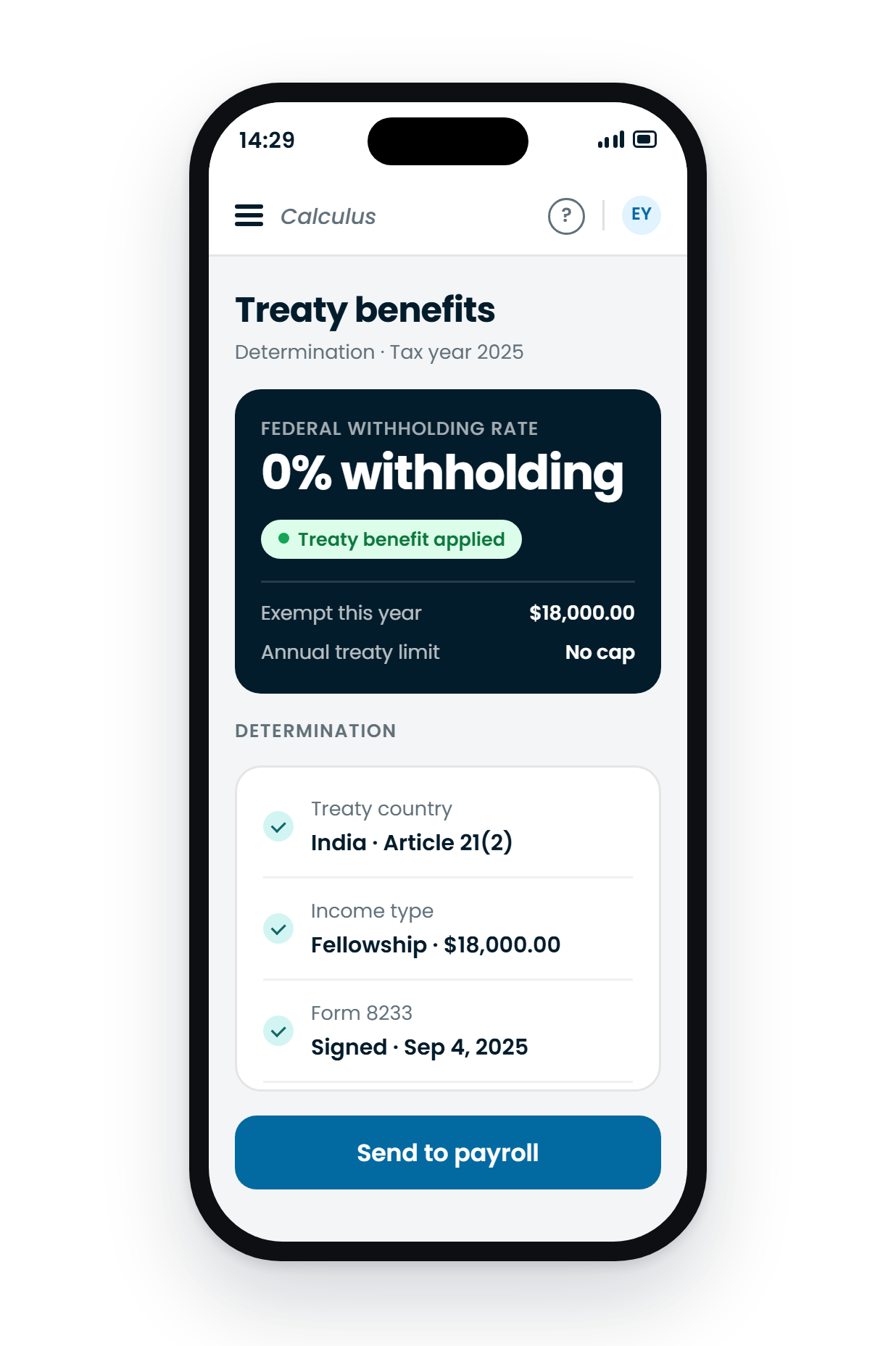
Sprintax Calculus easily determines treaty eligibility for every nonresident payment and applies the correct rate, every time.
Tax treaty determination for your nonresident employees
Apply the correct treaty benefits to each eligible payee, every time


about us
How do tax treaties impact nonresident payments?
The U.S. has tax treaties with more than 65 countries, and each affects nonresident taxation differently. But not every nonresident from a treaty country qualifies. Eligibility depends on the specific article, the income type it covers, and any dollar or time limits.
Where a treaty applies, it can reduce or remove withholding on that income type. Where it doesn’t, standard nonresident withholding applies.
If eligibility is misjudged, payroll offices risk over-withholding tax a payee could have avoided, or under-withholding on payments that were never treaty-eligible.
How Sprintax Calculus simplifies treaty determination
-

Every treaty, built in
Sprintax Calculus covers every U.S. tax treaty, so application of each treaty benefit is never left to manual lookup.
-

Expert support
Sprintax provides the tools, guidance and expert support you need to apply treaty benefits correctly and stay compliant with U.S. tax law.
-

Determine once, apply everywhere
Treaty eligibility is tied to each person’s residency status and income type, so a single determination drives the correct article, withholding rate and documentation automatically.
-

Built on trust and security
Our enterprise-grade tax security is backed by ISO 9001 and ISO 27001 certification, reflecting our commitment to the highest standards in quality management and data protection.
partner benefits
Book a call
Partner with Sprintax Calculus
Managing nonresident tax withholding and payroll at your school or organization? Book a call with our partnerships team and discover how Sprintax Calculus can help.

Accurate tax withholding calculations
Our system calculates nonresident tax withholding and determines whether they are eligible for any tax treaties or deductions.

Integrate with leading payroll software
We’ve built a powerful ecosystem with nonresident tax determination, withholding and payroll, seamlessly integrated via our open API.

Real-time reporting and admin dashboard
Access real-time reports through our cloud-based platform. Leverage high-level dashboards or drill down into individual tax profiles.
F.A.Q.
Your questions. Answered.
A U.S. tax treaty is an agreement between the United States and another country that reduces or eliminates withholding tax on specific types of income. Treaty benefits only apply to the individuals and payment types the treaty article is written to cover – not to every nonresident from that country.
No. Nonresident alien tax treaty eligibility depends on the specific treaty article, the income type being paid, and any dollar caps or time limits in that article. Qualifying as a nonresident from a treaty country doesn’t automatically exempt someone from withholding.
Treaty eligibility must be determined before the first payment is made to a nonresident. Organizations that pay nonresidents — including universities, employers, and financial institutions — are required to establish each individual’s treaty status in advance, not retroactively.
Once a treaty article’s dollar cap or time limit is reached, the treaty benefit stops applying. Any income paid to that individual after the limit is met becomes subject to standard nonresident withholding tax, typically at 30%.
Claiming a tax treaty exemption requires Form 8233 for compensation or scholarship income, or Form W-8BEN for other income types. The applicable form must be signed and on file before any reduced withholding rate can be applied.
If a country has no tax treaty with the U.S., the income falls outside the treaty article, or the benefit limit has already been used, standard nonresident withholding tax applies with no treaty documentation required.
Incorrect tax treaty determination leads to two compliance risks: over-withholding tax that a nonresident was legally entitled to avoid, or under-withholding on income that was never treaty-eligible – both of which can trigger IRS penalties and reconciliation issues.
Sprintax Calculus includes every U.S. tax treaty currently in force and automatically determines treaty eligibility for each individual, each tax year. It applies the correct treaty article, withholding rate, and documentation requirement, and records the reasoning behind every determination.