Nonresident payments, classified in seconds
Consistent, compliant income classification across every payment type and every payee


Managing U.S. income classification
If your organization makes payments to nonresidents, it’s important to classify each payment correctly before it’s made. Ultimately, how a payment is classified has a major impact on how that income is taxed.
The IRS has clear rules on classification. Different income types, such as wages, royalties, scholarships and fellowships, are each treated differently for tax purposes, with their own withholding rates, treaty articles and reporting forms.
It’s also common for one individual to receive different types of income from the same organization within a tax year, such as wages and stipend income. When this happens, you must classify and tax each payment on its own terms.
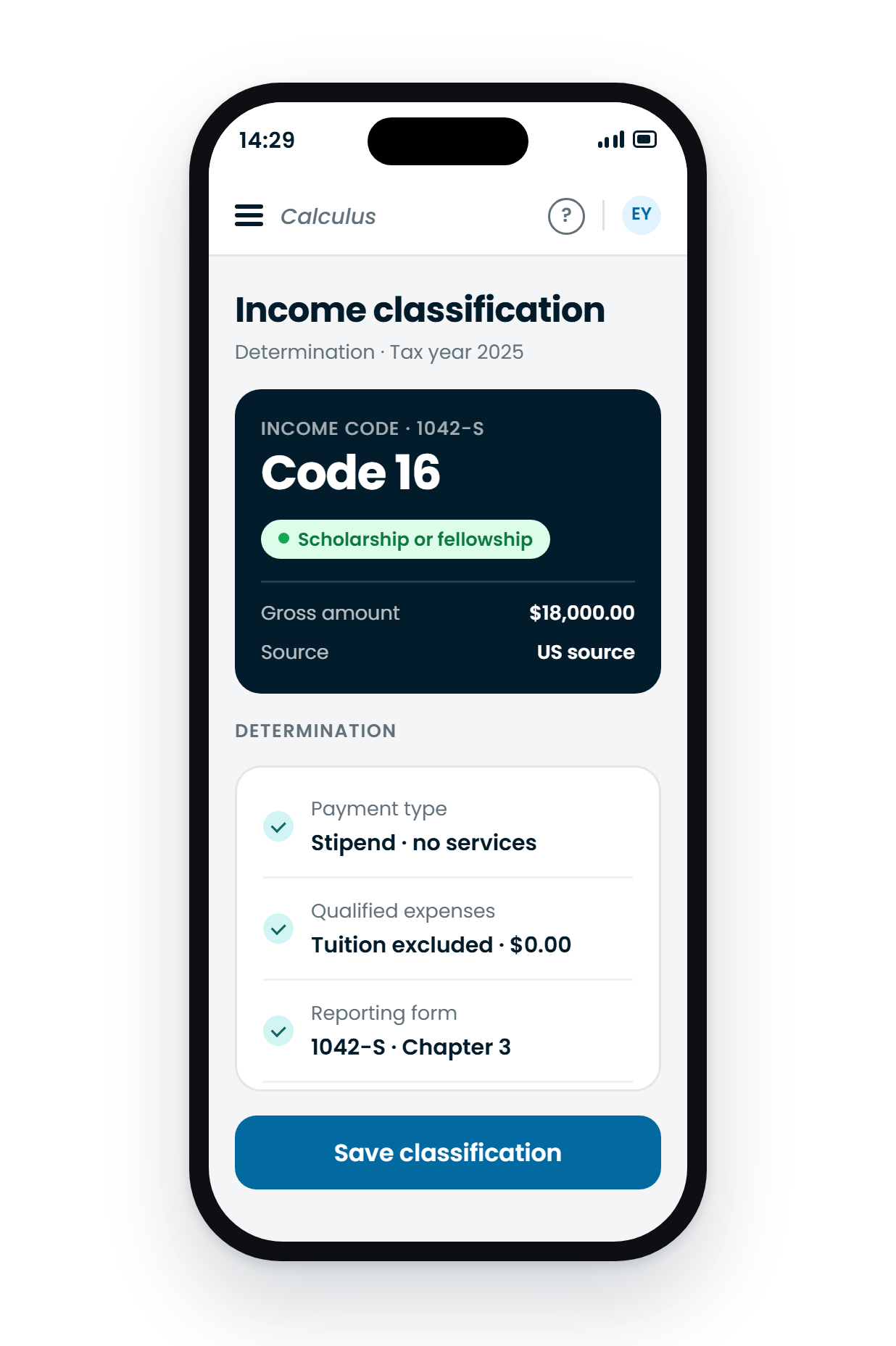
That’s where Sprintax Calculus comes in. Our solution classifies every payment you make to a nonresident and records the reasoning behind each decision, so you always know why a payment was treated the way it was.
How Sprintax Calculus simplifies income classification
-

Every payment sorted correctly
Wages, royalties, scholarships and fellowships are classified under the right IRS category automatically, not left to guesswork on a form.
-

Classify once, apply everywhere
Once a payment is classified, the correct withholding rate, treaty article and reporting form are applied.
-

Built for mixed income
Where one person receives more than one payment type in a year, each stream is tracked and taxed on its own terms, not blended into one rate.
-

Clean, audit-ready reporting
Classification carries straight through to 1042-S reporting, so nothing needs to be re-categorized or corrected at year-end.
Your questions. Answered.
Income classification is the process of deciding what type of income a payment to a nonresident is under IRS rules, such as wages, a scholarship, a fellowship grant or a royalty. The classification determines the withholding rate, which tax treaty article may apply, and which form the payment is reported on.
Each income type is taxed differently. Get the classification wrong and you could withhold the wrong amount, miss a treaty benefit your payee is entitled to, or report the payment on the wrong form. As the withholding agent, your organization can be held liable for any tax that should have been withheld but wasn’t.
Wages paid to nonresidents are generally subject to graduated withholding under special nonresident rules and reported on Form W-2, unless a treaty exemption applies. Taxable scholarships and fellowships are usually withheld at 14% for students and scholars on F, J, M or Q visas, and 30% otherwise. Royalties are generally withheld at 30%. Treaties can reduce or remove the withholding for any of these, and treaty-exempt or non-wage payments are reported on Form 1042-S.
Yes, and it’s common. A graduate student might receive a stipend and wages from a teaching role in the same year. Each payment has to be classified and taxed separately, with its own rate, treaty treatment and reporting, rather than combined at a single rate.
The key question is whether the payment is for services. If the person must work, teach or do research in return, the payment is generally treated as wages. If it supports study or research with no services required, it’s usually a scholarship or fellowship grant. Only the non-qualified portion, such as amounts for room and board, is taxable.
Treaties can reduce or eliminate U.S. tax on certain income, but benefits are tied to specific income types and articles. The same person might qualify for a treaty exemption on a scholarship but not on wages. That’s why classification must happen first: you can’t apply the right treaty article until you know what the income actually is.
Wages are generally reported on Form W-2, while scholarships, fellowships, royalties and treaty-exempt income are reported on Form 1042-S, each with its own income code. To claim treaty benefits, nonresidents typically provide Form 8233 for compensation for services or Form W-8BEN for other income.
Sprintax Calculus classifies every payment you make to a nonresident, applies the correct withholding and treaty treatment, and records the reasoning behind each decision. You get accurate withholding from the start and a clear audit trail if anyone asks why a payment was treated the way it was.